Saturday, March 5, 2016

6 Steps to Incorporate Guest Blogging as Part of Your Overall Content Strategy


According to research, high-growth professional services companies generate at least 40% new business online. And the one thing most of these organizations have in common is a consistent content strategy. They educate their target audience by sharing valuable information. And one of the best ways to reach an audience beyond your immediate reach is through guest blogging.

There are two main reasons that guest blogging should be part of your content marketing strategy:

It increases your brand's visibility and credibility with a wider audience, establishing you sphereYou gain authoritative SEO backlinks to your website.

Take a look at the 6 steps you need to take to get started with guest blogging.

6 Steps to Incorporate Guest Blogging as Part of Your Overall Content Strategy | Social Media Today

You may already have a few outlets in mind. If you don't – and many new bloggers won't – the first place to turn is Google. Search for terms similar to the topics you want to write about. Add "guest blog" to your keyword to see if that helps. See what your peers are sharing on Twitter and LinkedIn, as well. Your goal is to find the outlets your target audience read. You'll need to vet these outlets to confirm they're relevant, reputable, and active on social media.

Your competitors can also lead you to fresh outlets. Consider what competitors closely mirror your service offerings the closest – where are they blogging? Typically, folks aren't shy about promoting their content when it's published elsewhere. If you know the names of your competitors' leadership, you can even Google "John Doe ABC company" for some quick intelligence. You can also set up Google Alerts to let you know when they publish anything new.  

Over time you will develop a list of prospective outlets that make sense.

Start by researching the outlets on your list. Acquaint yourself on the issues covered in the last 6 months. Also look for patterns or clues that can help you shape your topic and pitch to fit their preferences. Doing so will greatly increase your chances of success.

Armed with this critical information, you can start evaluating your own content. Determine the best fit between your content and your prospective outlets. Then be sure to match these topics with your firm's service offerings.

Now it's time to dig in and write your pitches. Your pitch letter or email should cover some basics: 

Introduce yourself and your firm.State your intention (to submit a guest blog).Mention how it will fit will their readership.Provide a working title and main points of the blog (including any supporting research).

Keep it brief. Don't force the recipient of your blog proposal wade through more than a few sentences to get to the ask. So strike the right balance and make sure your outline isn't too complex or too generic.

Be sure your keep track of what online pubs you pitch which ideas. We recommend you start a simple spreadsheet with the editor's name and email, the name of the publication, the date contacted, and current status of the pitch. Have fields for the ideas you pitched and any other notes that might be relevant. It will help to include a link to the blog. (This will come in handy once your blog is accepted and published. See step 6.)

If you don't get a response, gently follow up in 2-3 weeks. Sometimes editors are inundated with email and things get lost in the shuffle (we've all been there). If you still don't get a response, try again with a different topic. If that fails, let it go for now. Keep the publication on your list and let some time pass – you can always return later with a fresh pitch.

Did you snag a guest post? Excellent. 

If you pitched an idea and outline, your next step – before any writing – is to nail down the important details with the editor. What's your deadline? What word count should you target? Chances are they'll have specific guidelines on both.

Also ask if you're allowed to link to your website from the post (after all, this is the payoff for all this labor), and how long your biographical blurb should be. Some blogs and publications are also willing to run your photo, so be sure to inquire and provide that, too.

And above all else, be sure to do a final proofread before you submit.

All your effort is for naught if no one sees your post. So, promote your guest post (and let the editor know that you plan to do so). Liberally spread the link across social media and include a shout out to the publisher.

Guest blogging is critical piece of your online marketing program, and it'll reward you with increased exposure and critical links back to your website.

Keep at it and watch your visibility and authority grow.

View the original article here


Original source: 6 Steps to Incorporate Guest Blogging as Part of Your Overall Content Strategy.
http://www.jretechnology.com

7 Productivity Secrets of Sports Champions To Emulate


7 Productivity Secrets of Sports Champions To Emulate | Social Media TodayTo stay ahead of the game, one of the main goals companies strive to achieve is to improve productivity. Increased productivity means higher revenues and a stronger bottom line. So how can you improve productivity in the workplace? In many of the same ways that you improve productivity on the sporting field.

Here's what some of the most successful sports figures have to say about how to increase productivity.

Football legend Steve Young said, "I was taught early on that I should plan my work and then work my plan. The best strategy in the world won't be effective if it isn't backed up with muscle and sweat."

Setting goals is a necessary first step, but it's only the first step. Make sure those goals are attainable, and then work to attain them.

If you're not measuring your performance, you have no benchmark for improvement. Cameron MacMillan, co-founder and COO of Daily Fantasy Sports site Rotogrinders says – when it comes to working with statistics – "Numbers don't lie; every incremental improvement you make can be measured and compared to previous productivity. A graph of your achievements, with the line going up, is just as good as a pat on the back from the boss."

Facebook is perhaps the biggest time suck ever invented. It's useful for a lot of things, but can also be detrimental to your productivity. Golfer Tiger Woods said, "I can either play golf or play on the internet — guess which one I chose?"

The fact that he actively chooses to pursue his passion instead of getting caught up in time wasting activities is what makes him such a great golfer. Angry Birds, Wikipedia, and YouTube can wait until after you get home. When you're working on a project, give your full attention to working on the project – if you let yourself get distracted, things will never get done.

On the other hand, no one can be productive all day every day. Vince Lombardi, the uber-coach of the Green Bay Packers, told reporters, "I not only plan to win, but also plan for player down time — it's a given that has to be factored in. Instead of pulling out my hair in frustration, I just leave some wiggle room in the schedule, so that when it happens I already have a way of dealing with it. That's why so many coaches go crazy — they never plan for player down time."

Down time can mean an accident or unforeseen circumstances that keep you from working, or it can simply mean taking a breather for a few minutes, and pausing to relax and unwind. If you don't do the latter, the chances of the former are much greater. Either way, if staying on schedule means working constantly, you'll find yourself behind schedule very quickly.

Sasha Trubnikov is a former Olympic shotputter from Russia and now a productivity engineer at Interactive Strategies. How does he keep focus? "I only try to beat my own record. That way I never waste any time getting mad at anyone else or being discouraged."

A little friendly competition in the workplace can actually help productivity to some degree. Seeing how well others are doing can motivate you to improve your own numbers. But in the long run, comparing yourself to others is detrimental. If you get caught up in the competition, you to lose sight of your actual goals – concentrating on improving your own performance instead of beating someone else's will help you focus more on the task at hand and ultimately motivate you to continue doing better.

Yankee legend and noted wordsmith Yogi Berra once quipped, "What's a calendar for if it don't keep my head empty for other things?"

Now we have more than just desk calendars. We have mobile devices that can store all of our important appointments, deadlines and other events. They can even send us reminders of what we have going on. This allows you to prioritize your tasks and budget your time, without having to be constantly worried about how many tasks and projects you still have coming up. Your calendar will keep you on task, and remind you of what you need to do. That way, you can keep your head clear for the work that's right in front of you.

Hockey legend Wayne Gretzky famously said, "You miss 100 percent of the shots you don't take." If you're afraid to act because you're afraid to fail, then you end up getting nothing done at all. You've failed, before you even began.

Sonja Henie, a Norwegian ice skater who parlayed an Olympic medal into a Hollywood career, is quoted as saying, "I was told I could skate but not act, or act but not skate — but I wanted to try doing both at the same time. It didn't scare me; my parents taught me that failure is only a detour, not a wall."

Learn to embrace those detours. They may hinder your productivity temporarily, but will improve it in the long run – particularly over those who aren't taking any shots at all.

The key to productivity is twofold: half planning and half hard work. Between the two, you can do anything you set your mind to. So get out there and give it 110 percent. If you do that, you can knock it out of the park, and win just one for the Gipper.

The post 7 Productivity Secrets of Sports Champions To Emulate appeared first on Launch & Hustle.

View the original article here


Original source: 7 Productivity Secrets of Sports Champions To Emulate.
http://www.jretechnology.com

Friday, March 4, 2016

5 Ways to Build a Customer Adventure to Better Connect with Your Audience


5 Ways to Build a Customer Adventure to Better Connect with Your Audience | Social Media TodayThe original "Choose Your Own Adventure" book was created by Edward Packard and titled the "Adventures of You." Between 1978 and 1998, it was a phenomenon for kids (and adults), because it was the first time the reader was given control over the outcome. With so many options to end the story, the unexpected twists brought the reader back to try it again and again.

If this behavior sounds familiar, it's because it also describes today's customers. With so many choices and ways to buy, customers are crafting their own "choose your own adventure" in their purchasing path. So as the author of your story, are you confident that you're connecting with your customers and showing them how they can be a part of building their own version of your story that makes them want to come back again and again?

Let's be real here: People buy because of people. It's our interactions and experiences with others – whether we know or even trust the source – that lead us to any purchase. This is what makes the buying cycle so sophisticatedly unique, every time, and out of our control as marketers. Combine this with varying levels of customer loyalty, and their overall satisfaction of every interaction with your brand, it's clear that their journey is going to be different every time.

What you can control is how much, as a marketer, you put into earning your customer's trust.

The quality of your content, information, and the choices you make to connect with them is under your control.

Here are 5 ways to build a customer adventure that is sure to connect with your current and potential customers:

The demographic is dead. Your message is everywhere and your referrals and influencers exist all over the place. I can't tell you how many times I've heard someone say that their potential customers aren't on Facebook. Wanna bet? They may not be on there for business, but as individuals they are being influenced through connections and friendships. Don't discount the shattered geographical boundaries that online networks have created; it's where interactions of all kinds – personal included – that open up new opportunities.

"Life is a journey, not a destination," said Ralph Waldo Emerson. Mapping out as many customer journeys that you can think of will help visualize unexpected interactions and steer experiences that will really matter to your customers.

Doing something for the first time only gives us a benchmark. It's the documented shifts along the way that ultimately gives us a better rule set for us to market against. After all, every experience is unique and different to a brand and customer. Next time you say "we know what works" if it's only been done once… think again. And don't be fooled; just because something can be measured, it doesn't mean it should be. If the information you're collecting doesn't directly relate back to a business objective, it can't be used to optimize anything (except your trashcan).

It's the total experience that shapes whether we buy something or not, and until a customer really understands what you're selling, their experience won't be complete. Depending on what you're selling, this can come in the form of a conference call demo, a face-to-face meeting over coffee or an in-store overhead conversation. You will never have complete context to inform your purchase without real human experiences.

As marketers, we strive to build programs that make stuff sell. But sometimes, the brand, product, or the service fails to deliver the same promise. Really understand what you're selling, find its best attributes and promote those to the top of the marketing plan. Then you can devise the very best case scenario upfront – one that's consistent with what you say, and what your customer experiences.

Today's customers are fickle and connected, and you'll never have total control over your brand experience – period. But by truly understanding what you're selling, how you're measuring success and seeing your customers as unpredictable humans, you can craft adventurous experiences that keep them talking and coming back for more.

This post originally appeared on Bryan Kramer's blog

Want Social Media Today updates in your inbox?

View the original article here


Original source: 5 Ways to Build a Customer Adventure to Better Connect with Your Audience.
http://www.jretechnology.com

Social Advocacy and Politics: Seller Beware


Traditionally, businesses avoid taking positions on public policy issues for the simple reason that their goal is to maximize sales. Taking an issue position runs the risk of alienating potential customers on the other side of that issue. But increasingly, businesses are finding that either their customer base is far more likely to favor a particular policy position or the company's leadership has a strong position that they are willing to endorse even if it costs some customers. Regardless of the reason, it is certain that businesses need to think carefully about taking a public-facing policy position and be willing to stick to their decision. Otherwise, they likely risk a social media marketing crisis.

Currently, Land's End is facing such a social media marketing crisis. In response to a recent photo shoot and interview with legendary feminist and founder of Ms. Magazine Gloria Steinem, Land's End was inundated with messages from upset, pro-life customers. Even though Steinem did not discuss abortion in her interview – focusing instead on women's equality – the angry voices were strong enough to persuade Land's End to scrub Steinem from its website. But then the retailer went a step further and removed a feature allowing customers to donate to the ERA Coalition Fund for Women's Equality by adding its logo to any Land's End product.

This full public pendulum swing led to irate messages from an entirely different set of customers, these being pro-women's equality and pro-choice. In other words, by endorsing and then backing down on a principled endorsement of women's equality, Land's End ended up angering all of its customers holding positions on either side of this issue.

Land's End's failure in this matter highlights the need for businesses to be committed to any policy advocacy positions they take. Rather than discourage businesses from engaging in issue advocacy, which I think more businesses should do, they should think through any advocacy campaign carefully in terms of both market impact and their principled commitment to the issue. And if they decide to take a stand, it should be a committed stand; an attempt to lead the conversation, rather than allowing themselves to buckle under pressure from loud activists.

Businesses need to understand that oftentimes activists can raise a loud protest that exceeds their actual numbers. Just because a group of customers get angry and loud about a position the business takes does not mean they represent a large portion of the company's customer base. Businesses need to do the math to determine the net impact an advocacy effort will have on its sales. And it should note that the potential loss of some customers will be offset by gains in new customers drawn to the company because of its issue stance.

Good market research, a clear understanding of a company's own commitment to an issue and an effective social marketing campaign must all figure into any decision to get a business involved in a policy debate. Do this work up front and then stick to your guns to avoid Land's End's predicament.

———

Alan Rosenblatt, Ph.D., is Senior Vice President of Digital Strategies at turner4d, where he provides cutting edge social and digital media strategy to organizations engaging in public affairs. His column appears every other Tuesday on Social Media Today. Read his previous columns here.

Want Social Media Today updates in your inbox?

View the original article here


Original source: Social Advocacy and Politics: Seller Beware.
http://www.jretechnology.com

Has Twitter’s Switch to Hearts Worked? Here’s The Data


Has Twitter's Switch to Hearts Worked? Here's The Data | Social Media TodayWe absolutely love Twitter. It's become one of the most exciting places to be in social media and a lot of it has to do with the speed and pace the platform brings to engagement. Brands love Twitter too. They know it's a great place for customer service. Engagement is fast and effective.
Twitter recently decided to change the rules a little – it can do that kind of thing, of course, because it runs the show. To switch things up, the platform decided to introduce "heart" button in place of the good old-fashioned star for "favorite" that everyone had known for years.

Most would consider this change to be cosmetic at best, but if you dig a little deeper, there are some people out there who think that the heart has changed the social media landscape dramatically.

Some like the change, many don't.

We've got the data so we decided to take a look and find out if the introduction of hearts has changed the way engagement takes place on the platform – we'll look at the details behind this change first and move to the numbers next.

Twitter has its own version of events as to how the change came about, and it has a clear definition of what a heart means on its own site. To quote:

"Likes are represented by a small heart. They are commonly used to show appreciation for a Tweet. You can see someone's likes by visiting their profile, and your likes are also visible on your profile."

So according to Twitter you're showing appreciation for a tweet by giving it a heart.

Then there's Chris Sacca. Sacca, a Twitter investor, wrote a long post back in June, 2015, which focused on where he wanted Twitter to put their focus. You can read the piece here (give it an hour to digest fully) – it discusses the platform in great detail. The good thing about the piece is the fact that Sacca genuinely loves the company, not just as a cash cow, but as a kind of 'mission company'. Read the piece, you'll see what we mean.

At one point in the piece, Sacca makes it clear that he feels that switching to hearts, instead of stars, will massively increase engagement on the platform. Many people have since shared Sacca's post, and it's well-known that Twitter executives have seen it too.

When was it written? June 3rd 2015.When were hearts instead of stars first explored by Twitter? June 2015.The official change from stars to hearts happened on November 3rd 2015So h?as it worked? Let's look at that next.

Twitter feels the switch has brought an increase in engagement on their platform. Comments from Kevin Weil, their SVP of Product mention a 6% increase in activity for existing users and 9% increase for new users.

"We put a lot of thought into a change as fundamental as replacing star with heart. We tested it a bunch of different ways across a bunch of different countries. Trying different icons, different words. The heart is a universal symbol. It's a much more inclusive symbol."

We took a look at our numbers to see if we could learn more. The results may surprise you.

Has Twitter's Switch to Hearts Worked? Here's The Data | Social Media Today

We looked at more than 1,500 Twitter profiles in the 3 month period before and 3 month period after the change to hearts. These profiles tweeted more than 2.2 million times receiving more than 21 million favorites in total during the 6 months.

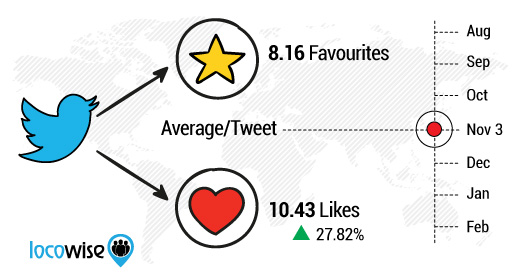
An average tweet in the 3 months leading up to the change to hearts got 8.16 favorites. An average tweet in the 3 months since the change to hearts got 10.43 likes. This is a 27.82% increase in people using that one button and must be considered a major success for Twitter.

Have you noticed any difference in your engagement since the change to hearts? You can use our Twitter Analyser tool to have a quick look at how you're doing.

The word 'like' is where the issue lies for those who are against the new direction.

You go to a store, you buy their stuff, and after a few months you keep buying more of their stuff. Eventually, you begin to realize that you rate their stuff higher than another store's stuff.

One day you stumble across a review site that is rating and collating all the reviews and info on stores like the one you have been visiting for months. The store in question is staring at you from your screen. Underneath there is a chance to click on stars, with five stars making it a highly rated store in your opinion, and one star making it a poor option.

Makes perfect sense right? Quality is gauged by the number of stars a provider gains – this system's been in place for a long time, and it works.

But let's say that you look at the same store on the site and instead of stars underneath the details you see a group of hearts. Five hearts means… what?

That you love the store? That you are fond of it? Or simply that you rate it highly?

Twitter replacing stars with hearts is something that, to some people, changes the nature of how we interact with tweets. We no longer simply rate the quality of a tweet, we show our love for it and that is a whole new ball game.

The whole issue centres around the notion of 'favorites'. If you star something, you are giving it a favorite. This wasn't that hard a concept to understand – but if you give something a heart you're showing that there's an emotional weight attached to that action.

People used to star stuff on Twitter because it was an easy way to lock onto tweets they wanted to check out later. When you are sifting through tweets and find an important news item, you would star the tweet. You can simply come back to your favorites at a later date, and in that way have your Twitter life pretty much organzed. And that worked. It also meant that you were able to find tweets that were genuinely interesting to you.

This is a great idea for news-based tweets, for example – people could simply star their notable news tweets that had floated into their stream and keep an eye on events. From terrorist acts to celebrity weddings, it made for an easier way to navigate the Twitter experience.

But issues like terrorist events are also where the switch to hearts becomes problematic for some. Starring a terrorist event to read a tweet about it later makes perfect sense – the tweet is notable, it rates highly because it's of interest. But adding a heart to a news tweet about a terrorist event? That, arguably, makes for a slightly more uncomfortable experience.

Twitter will have to deal with this perhaps. Doing this would mean categorising tweets, and Twitter is all about self-expression. Pushing a tweet into a bracket and not allowing hearts while all other tweets get the chance to receive hearts… it just makes everything messy. For now we're stuck with a new system that allows people to 'spread the love' about horrible news events.

We looked at more than 1,500 Twitter profiles in the 3 month period before and 3 month period after the change to hearts. These profiles tweeted more than 2.2 million times receiving more than 21 million favorites in total during the 6 months. An average tweet in the 3 months leading up to the change to hearts got 8.16 favorites. An average tweet in the 3 months since the change to hearts got 10.43 likes. This is a 27.82% increase in people using that one button and must be considered a major success for Twitter. Have you noticed any difference in your engagement since the change to hearts? You can use our Twitter Analyser tool to have a quick look at how you're doing. Let's take a deeper look into why some people are against the change to hearts.

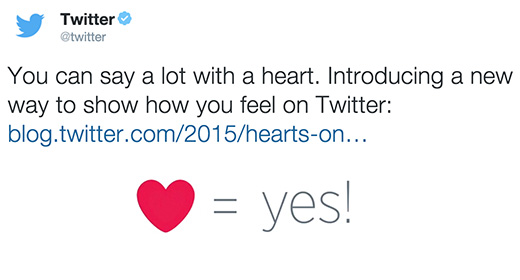
Take a look at the tweet that gave us the launch video. Watch the launch video and see why people are starting to think Twitter may have missed out on something here. The video is all about love and passion and all of that social media stuff that works on other platforms.

Most platforms face bumps along the road of their growth, but it's all about taking a look at what is going on and trying to change for the better without losing your core fans. That's what Twitter's trying to do with hearts, the algorithmic timeline and other experiments.

The problem for Twitter is that they have many die hard fans who love the platform as it is and don't want it to change in any shape or form.

With Twitter continuing to slide on the stock market, is making their loyal fans unhappy a gamble they can take? They need to, and the first 3 months of data shows that the change to hearts has paid off in a big way.

The post Has Twitter's Change Of Heart Worked? Here's The Data appeared first on Locowise Blog.

Want Social Media Today updates in your inbox?

View the original article here


Original source: Has Twitter's Switch to Hearts Worked? Here's The Data.
http://www.jretechnology.com

Twitter Provides Tips for Creating More Effective Tweet Content


Last month, Twitter introduced a new option which raised the hackles of many a seasoned Twitter user.

That option? An algorithm-defined timeline.

Twitter Provides Tips for Maximizing On-Platform Engagement | Social Media TodayThe idea of an algorithmic timeline for tweets has been in discussion for some time – the actual roll-out and had even been leaked by BuzzFeed the week before the official announcement. BuzzFeed's report subsequently lead to the creation of a new hashtag – "RIPTwitter" – which was used by thousands of people to voice their displeasure at even the suggestion of such a change to how Twitter works.

That backlash may have actually lead to Twitter making the algorithm-defined timeline opt-in – a detail which was highlighted repeatedly throughout Twitter's various announcements on the addition. But nevertheless, the option is here, and it is being used by some, so Twitter's taken the opportunity, via their Small Business blog, to highlight the potential impact of the change, and what it may mean for businesses looking to maximize their engagement via tweets.

The potential problem: People may see fewer of your tweets if they're not generating enough engagement, as the algorithm won't see them as important.

Twitter's advice to counter this: "produce sparkling content"

Okay, there's more to it than that – Twitter's actually provided seven tips to help brands up their engagement and ensure their tweets don't get lost in the shuffle as users switch to their algorithm dictated feeds.

Those tips are as follows.

As per Twitter's post:

"To be heard in the noisy environment of social media, it's crucial to have a clear voice that channels your business's personality. For example, is your business inspiring, playful, or a serious authority? Use language and tone that conveys the key attributes of your business."

This, as always, is a relevant point – before you can use social to spread your message, you need to define what that message is and how you're going to communicate it. In large part, this'll be aligned to your brand mission, but it'll also come down to your target audience and what resonates with them. And the best way to learn that is to become part of your target online communities, get yourself attuned to how they discuss topics, how they use hashtags, what issues are of relevance. And then, the next part is to test – try different approaches and see what generates the best response.  

As highlighted in this example from woot.com, the tone and style you choose can play a big part in your social outreach strategy.

Of course, this is largely along the same lines as the first point, but Twitter suggests that brands should also employ a platform-specific approach to this process by utilizing their Twitter audience insights data to get a better understanding of who their followers are and what they're interested in. Twitter demonstrates this with an example from British pension scheme Nest, which, through insights, was able to determine that football is a key passion among their target audience.

Twitter suggests that brands consider how they can utilize popular events and align them to their brand message – but importantly, Twitter also notes that those events don't have to be global-scale trends:

"Remember, these can be everyday, personal events like breakfast or lunch, as well as wider cultural events, like Valentine's Day or Chinese New Year."

In the first example, Pressed Juicery highlights breakfast ideas, with a very good looking photo (that would also resonate on Instagram, I suspect). While you may not consider breakfast an 'event', as such, it's a relevant point – events are essentially anything that inspires a gathering, and if you can align your brand with that and highlight the relevance of your product/service in one image, that's a great way to boost your message via tweet.

In another example, Twitter shows how how Cure & Simple Bacon used creativity to tap into the wider discussion around Valentine's Day.

It's an interesting example in itself – though I would question the resonance of such messaging – this particular tweet has no re-tweets, no likes and five total replies.

Either way, it does highlight the point that you can look at events from a different perspective with a view to boosting engagement by using trending hashtags. Trying to wedge in an off-topic or forced reference with a rising tag isn't the way to go, but there are ways to approach those engaging topics in ways that can help boost your overall reach.

"Use videos, GIFs, photos, and emojis to attract people's attention and slow down the speed of their Twitter feed. People are three times more likely to engage with Tweets that contain videos and photos."

We've all heard the stats about videos – that videos generate the most engagement, that users are growing to expect to see more video content simply because they can, due to improvements in mobile connectivity. Twitter itself has produced various research reports on this, finding that that tweets with images can generate up to 313% more engagement than those without, while 82% of Twitter users watch video content on the platform. There's little question that videos work, and with the continued rise of emoji options and the recent addition of the new Twitter GIF button, it's now easier than ever to attach visual content to your tweets. And it may well be worth that extra effort.

Twitter's advice on this front is two-fold: you can use unique, branded hashtags to make it easier for your audience to find your content, or you can tap into a trending hashtag conversation to extend your content reach.

As previously noted, don't force it, but getting your brand into those trending discussions could be highly valuable.

This one's pretty obvious, yet it's still an element that's overlooked by many. Responding to queries via social – and quickly, if possible – is one of the best ways help build your brand presence and extend your messaging through positive word-of-mouth.

This is particularly relevant via tweet? Why, because stats show that more than 80% of customer service requests on social come through via tweet – and that there's been a more than 2.5X increase in the number of tweets to brands and their customer service handles over the past two years.

The immediacy and public nature of the platform has made it a go-to reference point for many people seeking to get their questions answered – ignoring this element could be a major error, and could be hurting your brand more than you think.  

Twitter's also working to put more emphasis on their customer service capacity, recently introducing a new option to prompt users to switch the conversation to DM if you need more context or to share personal details. While Facebook continues to grow its business offerings, Twitter remains a key customer service channel for many – responding to tweets is, really, just basic good practice.

And Twitter's final tip on how to 'produce sparkling content' is to ensure you're highlighting and celebrating your advocates where possible – which they've exemplified with a great tweet to LocoMetric.

Re-tweeting positive reviews or responses can be a great way to boost customer loyalty and advocacy, and even the simplest action like 'Liking' one of their tweets can be alot more significant for them than it is for you. People are on Twitter to be part of the wider conversation, to have their voice heard on the global stage. Those brands that hear it are the ones that are on track to win out in social – it's important to consider how you can recognize and acknowledge those community members that have gone out of their way to mention you in the first place.

There's some great tips here – mostly basic, core advice, but relevant and important, either way.

Will the new algorithmic timeline cause a reduction in tweet reach for many brands? I'd say it's not likely, particularly with the option being opt-in (most people won't bother to go to the effort of actually switching it on, I'd suspect). But then again, if the feedback about the algorithm is good, and if tweet engagement goes up as a result, I wouldn't be surprised to see Twitter switch it to an opt-out tool, making it the default display for all users.

If that happens, then that might change the conversation somewhat, making tips like these even more relevant to ensure you maximize your Twitter efforts. 

View the original article here


Original source: Twitter Provides Tips for Creating More Effective Tweet Content.
http://www.jretechnology.com

Thursday, March 3, 2016

Take Your Community from Good to Great


In the bestselling book, Good to Great: Why Some Companies Make the Leap…and Others Don't, author Jim Collins says: 

"Good is the enemy of great. And that is one of the key reasons why we have so little that becomes great."

As a community manager, you've invested time and effort into making your community a valuable resource for your audience. You drive conversations and deepen the relationships community members have with your brand. You strive to increase membership and activity within the community, engage with new users, respond to questions and comments within the community and introduce new topics. Overall, it's a success – but how can you transform a good community into a great one?

In the quest to become more effective, here are three questions community managers should ask themselves:

As a community manager, you make engagement a priority. You understand that the relationships you have with your employees or customers – and the conversations they have with each other – fuel the success of your community. However, when was the last time you acknowledged the top contributors that helped you achieve such high engagement levels?

To go from good to great, you need recognize those participants that are the backbone of your community's success. These are the community members who initiate quality discussions and share their expertise. To sustain active involvement, you must reward their efforts.

This can be done in a variety of ways. For example, an insider group grants active contributors special access, permissions, power and perks. It also provides them with a sense of ownership in the community. The group enables members to share their insight into the needs and interests of your community.

Or, reward top contributors with badges, reputation points, and expert status. Gamification is not only a fun way to recognize active users, is can also lead to organic engagement and community growth.

Companies can have private and public communities. Whether your community consists of employees or customers, it's important to gather feedback from your target audience. 

This open dialogue serves two purposes; it allows the audience to feel appreciated and heard, and enables companies to build a more valuable user experience.

As a community manager, it's your responsibility to not only collect feedback, but use ideas and suggestions to improve where necessary or add new features to the community.

Research shows that communities can increase the average amount of customer spend, attract new customers, and reduce support costs. As a community manager, you need to define what success looks like to you, as well what it means to your organization.

Evaluate metrics related to engagement, community growth and actions tied to revenue – such insight will enable you to prove the community's return on investment and allow you to more effectively promote and nurture engagement, and create a more satisfactory user experience.

Just as the needs and wants of your community will change, so too will the definition of a great community. This presents both a challenge and an opportunity for community managers – to maintain momentum and achieve success, community managers need to continuously evaluate their efforts, build valuable connections, incorporate feedback into the community experience, and analyze key metrics.

There is nothing more important to a community manager than an open feedback loop. A quality community manager is listening as much as speaking, leveraging the feedback communicated by the users to make informed business decisions and to provide a reason for the users to become repeat-users and promoters.

Main image via Shutterstock

View the original article here


Original source: Take Your Community from Good to Great.
http://www.jretechnology.com