Are you using your Facebook page to grow followings on other platforms?
Promoting links to all your social profiles on Facebook lets your fans know where else they can find you.
In this article you'll discover six ways to promote your social profiles on your Facebook page.
Discover how to cross promote your social profiles with Facebook.
You can add links to social sites in the About section of your Facebook page. Add them to any part of your description where they fit.
If you include a link in your short description, it shows up in the About area of your main Facebook timeline.
On the EasyLunchboxes page, special arrow characters highlight the social links. If you want to use these characters in your About section, just copy and paste them from another site.
Add links to social sites in the About section.
Your cover photo description is one of the most underutilized places for text and links. When someone clicks on your cover photo, they see the full description of the photo, so you can add anything there you want to promote.
List your social sites links in the description area of your cover photo.
While this may not bring you hundreds of new followers on all of your social profiles, it's such a quick and painless edit, why wouldn't you take 10 seconds to do a little cross-promotion?
Adding a Facebook app to your page, also known as a tab, can be a great way to show visitors your other social media profiles. Third parties (not Facebook) develop these apps and they all work slightly differently.
Here are some of the apps that easily bring in your other social accounts to your Facebook page:
There are many more apps that can also help you with adding a custom tab to your page.
Your apps can also appear in the left sidebar of your timeline, and you can customize the thumbnail so it matches your branding.
The top three apps on your page appear in the left sidebar and can have custom thumbnails.
One of the benefits of adding your social site links to your page is that people can easily follow you from the tab and see your activity.
The first app listed also appears just under your cover photo. Your social tabs are automatically updated with your latest posts.
Remember that mobile users can't see your tabs on their phones, so if youinclude a link to your tab, make sure it's "mobile-ready." This means it has a special link that identifies when users are on a mobile device and takes them to a separate site that shows your tab content.
You can put together a Facebook album with icons from your social channels and include social links in the photo descriptions. When you initially share this album, your followers will see it, and you can always reshare a link to the album as a fun way for people to see your profiles on other social sites.
Use all of the social icons as images in a photo album.
The benefit of putting the photos in an album is that they're a little more visible than a single image that gets pushed down in your uploads as you add more pictures.
In the photo description, add the link to your social site.
Sharing content from other channels with your Facebook page helps you cross-promote all of your social profiles and makes it easier to post content in multiple places.
But always remember the true goal. If you're really trying to drive traffic to a blog post, for example, it doesn't make sense to share the tweet of the pin of the blog post to Facebook. It would take someone too many clicks to get there. But some occasional sharing from your profiles on other social sites helps draw attention to those channels.
If you have share buttons, sharing content from your other social profiles with your Facebook page is usually just a matter of switching the destination to your page.
Sharing from another social site to your page is usually just about switching the destination.
On Instagram, sharing your posts with your Facebook page is a matter of changing your settings. By default, Instagram shares images with your personal profile when you connect Facebook to your Instagram account.
To change the sharing destination of Instagram images from your Facebook profile to your page, open the Instagram app and go to Settings (the three dots in the upper-right corner when you're looking at your profile). Then tap Linked Accounts.
Change your Instagram settings on your mobile device.
Now tap Facebook to make changes to the destination.
Tap Facebook to make changes to your Facebook destination.
Edit where you want your Instagram photos to go when you tap Share to Facebook.
You can select a page to send your photos to instead of your personal profile.
If you only want some photos to go to your Facebook page, you have to manually change this setting before sharing. Or you can set up a workaround such as an IFTTT recipe (discussed in the next section) to send only some images to your Facebook page.
A little automation can be good. While it's a great idea to post natively to social sites so you can upload properly sized photos or tweak the language to fit the site, sometimes it's handy to post to several of your profiles with the click of one button.
There are a lot of tools that can help you do this, and the list below is by no means exhaustive. Here are a few ways to automate:
Send all of your Facebook page posts to Twitter by connecting them here. This option isn't recommended for everyone, as your posts get cut off at 140 characters (with a link back to the original Facebook post) and you may not want every post to go to Twitter.
Use tools to post to several profiles at once. These tools allow you to craft your post and then select which social profiles it will go to. Many of the tools have other features as well, such as analytics, special scheduling and team management.
Use IFTTT to create rules around a type of post or share that you want to automate. For example, if you want to put some images for an event in a special Facebook album, you can create a recipe to automate the process.
Use IFTTT to create special rules around social sites and sharing.
By making others aware of your Facebook page and connecting in multiple places with people, your messages are more likely to be seen.
Think of your own browsing habits and how often you see messages in all places at once. If you're anything like me, it's probably not that often. So don't worry about overwhelming your audience with the same messages if you post in multiple places.
Conclusion
I find that most businesses err on the side of not promoting their other social real estate often enough. Make sure you're using some of these tips to get the word out about your other social channels.
How about you? Are you cross-promoting links to all your social media profiles? What is working best for you? Share your thoughts in the comments below.
(function(d, s, id) { var js, fjs = d.getElementsByTagName(s)[0]; if (d.getElementById(id)) return; js = d.createElement(s); js.id = id; js.src = "//connect.facebook.net/en_US/sdk.js#xfbml=1&appId=167506593384213&version=v2.0″; fjs.parentNode.insertBefore(js, fjs);}(document, 'script', 'facebook-jssdk'));About the Author, Andrea Vahl
Andrea Vahl is co-author of Facebook Marketing All-in-One for Dummies and also uses her improv comedy skills to blog as Grandma Mary, Social Media Edutainer. Connect with her at http://www.andreavahl.com/. Other posts by Andrea Vahl »
The Marvel Comics vs. DC Comics rivalry is almost as old as the comic medium itself. But now that we've entered the era of blockbuster superhero movies making billions of dollars in the networked world of 21st century social media, there is quite a lot at stake in the social strategies of these ostensible comic book companies' movie studios. So who's winning the social media battle between Marvel and DC? Well, I could be magnanimous and say that each side has its strengths and weaknesses and other even-handed things like that, but it wouldn't be the truth. Marvel is winning. Because it's the one having the most fun.
It is important to know that, when it comes to comic book and superhero movies, the PR efforts of movie studios are as much about reassuring fans that they understand and will protect the characters as much as it is about promoting films. Comic book readers can be fickle (and I would know, I am one), and it can break a fan's heart, and more importantly create a lot of bad buzz, when they see a studio 'missing the point' of the characters that they know and love. So, what is Marvel doing right?
Rather famously, Marvel was set to release the first trailer for their summer tentpole feature Avengers: Age of Ultron in the middle of a broadcast of their spin-off television series Agents of S.H.I.E.L.D. It was a smart, synergistic strategy to get the tailer out to their hardcore fans, who were probably watching the show anyway, and boost the show's ratings by getting those excited about the movie trailer to tune in for the TV show. And then the trailer leaked a week early.
Marvel did the smart thing and rolled with it. The leaked trailer was a blurry, pixelated mess, so Marvel quickly uploaded an HD copy of it. And rather than give up on the synergy with Agents of S.H.I.E.L.D., they still included the trailer on the show, but with extra footage to entice fans further. Most importantly, they even cheekily referenced the whole mess in a meta tweet:
Laying the blame at the feet of the evil organization that played the villains from Captain America: The Winter Soldier was clever social marketing. And it saved the company the trouble of sending out endless DMCA takedown notices to sites hosting the leaked trailer in a futile game of digital whack-a-mole while they waited a week to release the real thing. In terms of dealing with a social media crisis, it was a win. (It should also be noted that while Marvel handled the leak well in public, it has also made efforts to discover the source of the leak and protect its brand.)
Meanwhile, DC Comics has … put out photos of the Batfleck? Maybe, because DC hasn't had the opportunities Marvel has had, they could still show as much of a sense of humor, but it hasn't happened yet. Instead, there have been a lot of promotional pictures that haven't been entirely well received, and a super serious trailer for their own upcoming blockbuster Batman v Superman: Dawn of Justice.
The thing is, it isn't just the fact that Marvel's social media team knows how to deal with a crisis that makes them the winners here. What separates Marvel and DC in their approach to social media is that Marvel seems to be honestly jumping into the spirit of its own stories and characters, while DC is just promoting its movies. Marvel's twitter feed is fun and light-hearted. DC's twitter feed, well, promotes DC projects and properties. Which is fine, but doesn't do much to change the general view that while Marvel's movies are fun and joyful, DC's are gritty and dour.
Here's the best example: Marvel's character Deadpool has a movie coming out next year starring Ryan Reynolds. This is Deadpool:
Via Marvel Comics Database
Deadpool is an irreverent fan-favorite character in the Marvel universe who is a deadly assassin who also happens to be deeply insane. In the comics he breaks the fourth wall regularly, constantly mentions to other characters that they are in a comic book, has conversations with his own narrator, and can see the little yellow boxes of text that follow him around everywhere. He is a very weird and strange character. So how does this relate to social media? The Deadpool movie's twitter account is following exactly one other twitter account:
If you wanted to reassure your fans that yes, you understand the spirit of the characters you are putting on film, that you get it, this is exactly how you do it.
If you've been reading my column for the last while you'll see what catches my eye, and the majority of the public – sex sells, but not as well as it does when combined with humour. I also have a thing for Star Wars, but that is well beside the point.
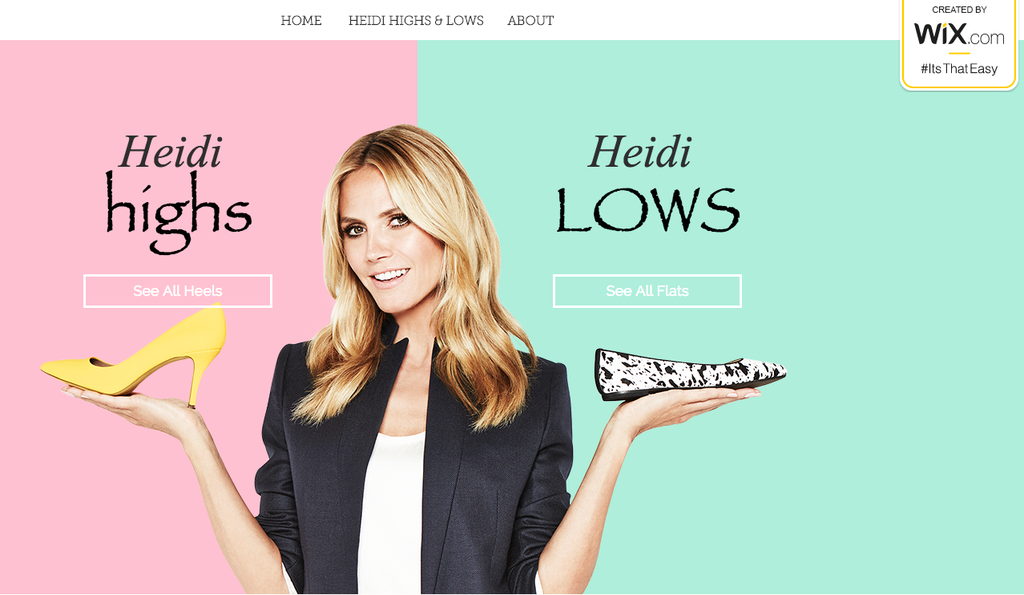
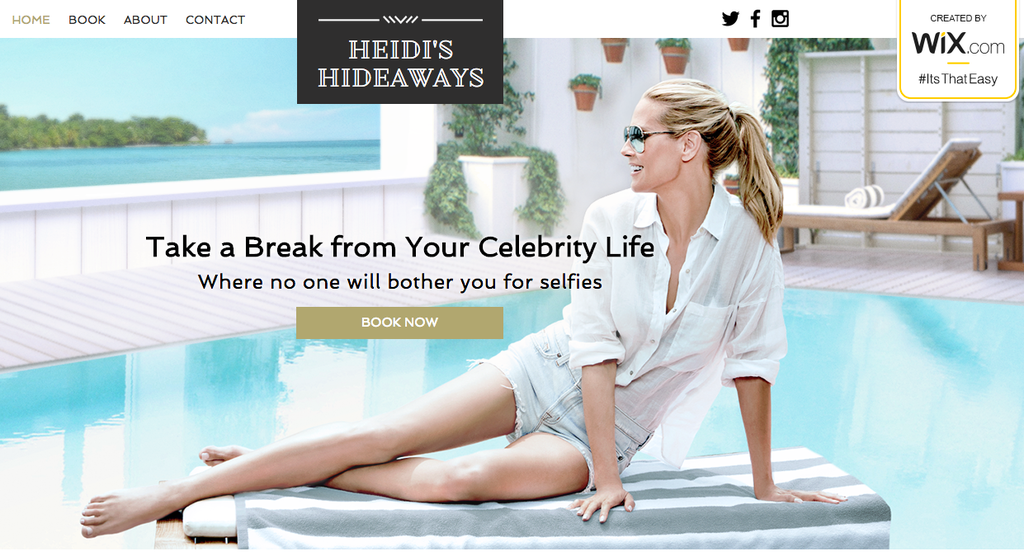
When you have access to a spokesperson like Heidi Klum, you get to work on putting her commercials out as often as you can. If she's sitting comfortably in a bedroom with some sexy clothes on while you're at it … it never hurt anybody. That is what Wix.com have been doing with Heidi for their #ItsThatEasy campaign.Wix.com have been working with Heidi Klum in a series of commercials, some shorts, some longer. The longest one just launched last weekend and it has been a lot of fun …and it has also found an opportunity to star Heidi's legs:There are also shorter ones that are quick and cute:Cute, but what else have you got? This is a content marketing column and we need more than 'cute.' How about the fact that all of the silly things she pitches have 'real' viral websites built for them:
The point of the commercials is to show people how easy it is to use Wix.com to build a website. Visiting the websites that they set up for Heidi's faux=products shows you clearly that you can create a great website using their service. That's pretty important and they do make the point with a reminder in the upper right hand corner of each website:
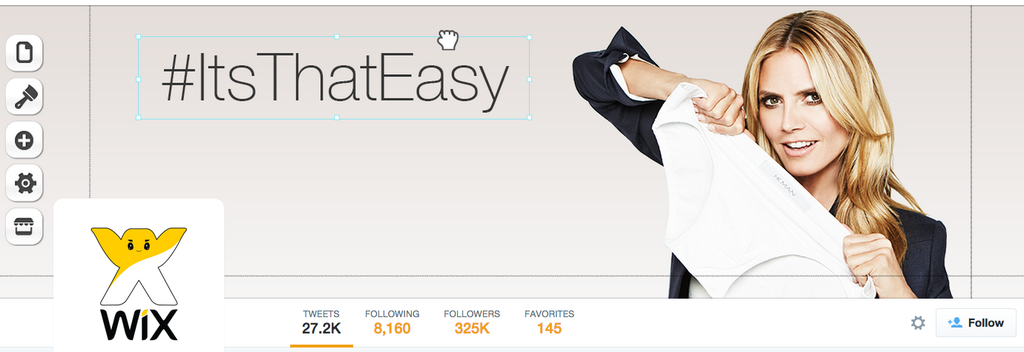
They really worked their product into the campaign.Wix.com has used the imagery across their social profiles to stay on message and help people learn about the #ItsThatEasy campaign: The hashtag has also seen some good usage on their Twitter account, and they've expanded past just Heidi related content to get people thinking about their own zany ideas:
Have a wacky biz idea? Join Wix's 'Name A Wacky Biz' Challenge & win fab prizes! #ItsThatEasy http://t.co/myjueWyNNh pic.twitter.com/BV0haQDr5d— Wix.com (@Wix) May 13, 2015
This is an excellent opportunity in user generated content marketing. The #It'sThatEasy hashtag has been seeing some heavy use for it, and that's good …but more on that later.Last, I think this is a good example of equality as they're sure to not just focus on a beautiful lady: #ThoselegsThey also give the ladies, and gay men too I suppose, a little eye-candy: Whoops! Wrong one: There you go, they show off a lady suggestively, they show off a man suggestively, now we're all equally offended and pleased. This is really no fault of Wix's, but their hashtag has been spammed like crazy by brand-new website 'developer's looking to get cheap promotion for their website: It seems like they have some sort of 'tweet it out' button that sends these messages over and over. I wish Wix would (say that 10 times) just let people do it on their own so that there was more uniqueness. Useful tweets using the hashtag are being drown out. Wix's own tweets using the hashtag may as well have never happened.I'm also a bit disappointed that they didn't link directly to Heidi's 'websites' right off the video in the description, or in a YouTube Annotation. That would have really driven engagement with the content. They don't even have any sort of push at the end of the video to get people to watch other videos in the series, or visit their own website. Someone needs to teach Wix about Annotations and proper YouTube marketing.Apparently this Rex Lee guy is a big deal as well…but I don't know him. Therefore it's a part of the ad I don't like. I am completely biased on that front, I'm sure he's great at whatever-it-is he was in.Content Marketing Minds is an exclusive Social Media Today column written by Matthew Yeoman every other Wednesday.
Do you want more people to talk about your brand or business?
Want to discover how to get the ball rolling?
To learn about word-of-mouth marketing, I interview Ted Wright.
The Social Media Marketing podcast is an on-demand talk radio show from Social Media Examiner. It's designed to help busy marketers and business owners discover what works with social media marketing.
In this episode I interview word-of-mouth marketer Ted Wright, author of the book, Fizz: Harness the Power of Word of Mouth Marketing to Drive Brand Growth. He's also the founder of Fizz, an agency that specializes in word-of-mouth marketing. His clients include Intuit, Pabst Blue Ribbon, Verizon, Intel and many others.
In this episode Ted will explore word-of-mouth marketing.
You'll discover why word-of-mouth marketing is important in the age of social media, as well as things you can do to get people talking.
Listen as Ted Wright shares insights on using word-of-mouth marketing to get others talking about your business.
Share your feedback, read the show notes and get the links mentioned in this episode below.
Listen now: Play in new window | Download | EmbedYou can also subscribe via iTunes, RSS, Stitcher, SoundCloud or Blackberry. How to subscribe/review on iPhone.
Here are some of the things you'll discover in this show:
How Ted became interested in word-of-mouth marketing
Ted talks about when he attended the University of Chicago School of Business in 1999. At that time the computer lab was basically a windowless cave with 20 rows of 20 computers each, Ted recalls. Early one morning working in the lab, he noticed the ambient light was blue. It was because the Netscape screen was mostly blue, and that's the site everyone used.
Fizz by Ted Wright.
After 20 minutes or so of searching fruitlessly and getting frustrated with Netscape, somebody leaned over and suggested Ted try Google, which he did.
Ted's test search term was his mother's name, Dr. Lynette Wright, a fairly famous medical geneticist. However, since they share the same last name as the guys who invented airplanes, most search engines easily got confused.
"Google returned my mother as the second search term, instead of eight pages deep, which was the norm for other sites," Ted shares. He kept working and 20 minutes later, Ted noticed the guy next to him getting frustrated. So Ted leaned over and explained Google to him.
About four or five hours later, Ted finished working, stood up, looked around and noticed the light in the room changed from the ambient blue of Netscape to the ambient white of the Google screen.
Ted, who's always trying to figure out how things work, found that very interesting. So during his second year at the University of Chicago, he blew apart the history, math, psychology and epidemiology of word-of-mouth marketing.
After graduation, Ted decided to start his own business. That company, which he started 15 years ago, is now called Fizz.
Listen to the show to discover the unique way in which Ted watched TiVo and Google get adopted.
The importance of word-of-mouth marketing
Ted defines word-of-mouth marketing as "identifying your influencers and coming up with a story that is interesting, relevant and authentic that ladders back to qualities of your brand and then sharing that story as much as possible."
Word-of-mouth marketing is important in storytelling. Image: Shutterstock.
That's the first part. The second part, Ted says, is "creating for your influencers as many opportunities as you can as a brand or a company for them if they feel like it to share your brand's story with as many people as they would like to do so."
Ted shares the word-of-mouth marketing campaign he ran for Pabst Blue Ribbon (P.B.R.) with the brand manager at the time, Neal Stewart. The goal was to get more people in America to drink P.B.R.
Ted identifies the three critical components of a story being shared:
Is the story interesting to influencers so they will pick it up, study it and really understand it?Is it relevant to influencers' audiences?Is it authentic the way they currently understand the brand and the category in general?
With all due respect to the people who make P.B.R, Ted says, they were never going to win by talking only about taste. So they decided to focus on what's going on outside the can.
Ted explains how at the time (around 2000), most young adults who just hit drinking age were likely born in 1980 or earlier, and had a good chance of being the children of yuppies (young urban professionals). Yuppism (in the 1980s and 1990s) at its extreme is about having things just to have things. The children of yuppies appreciated these benefits while they were growing up. However, right after graduation, they rejected all of their stuff. This was happening in 2000, and became known as Hipsterism: a rejection of things and a rising importance of experience.
Therefore, Ted and Neal decided that as a brand, P.B.R. would celebrate people who were doing interesting things because they wanted to be doing them, not because they wanted to be seen doing them.
They found people who were interested in cool things such as bicycle races, hipster bartender golf tournaments and bands like Minikiss. They hired them to go to events they were going to anyway. Then if someone asked, they could talk about P.B.R. As a brand, they were the first ones to listen to people and be genuinely interested without asking for anything in return.
Fast Company recently named P.B.R. as one of the biggest turnarounds in the last 20 years.
P.B.R. sought out interesting people and events, like Minikiss, a Kiss cover band made up of people under 4 feet tall.
Ted does not believe this is the age of social media—he believes it's the age of conversation. In the beginning, social media made it very easy for people to understand just how much conversation was going on about many different things. For word-of-mouth marketing, all of the tools in social media are important for keeping the conversation going.
"When you get face-to-face interaction working with social media, that's when 1+1=3," Ted says. "Neither by itself works nearly as well as they do in combination."
Listen to the show to hear why Ted compares marketers to plumbers.
How to get people talking
The first thing to do is figure out your story and make sure it's interesting, relevant and authentic.
Then, Ted suggests, do what he refers to as the brunch test. You can either actually go out to brunch or just use your imagination. To do it as a mind experiment, close your eyes and pretend you're out to brunch with your significant other and two other couples: one couple you know well, the other you don't. When you start sharing your brand's story, is everyone leaning forward and asking questions or is your significant other kicking you under the table because you're boring? That is one of the tests for interesting stories.
The next thing to remember is you don't identify your influencers—your influencers identify themselves to you.
Influencers have three particular personality traits: they like to try new things because they're new, they like to share stories with their friends and they're intrinsically motivated. Because they like to share stories with friends, they're always swimming around in the sea of commercial information, looking for bits and pieces of stories or things that interest them.
On average in the United States, a person is influential in three or fewer categories. Ted says while he may be really influential for cars, he may not be influential for cell phones. So when he needs a new cell phone, he asks a friend who is an influencer.
An average word-of-mouth exchange is only 32 seconds long. So there's a lot of trust and information that's communicated. Within that, 20% of everything that is sold in the U.S. is sold solely because of that conversation.
Ted explains how to narrow down your market to find the right influencers. Next, figure out where they co-locate physically and virtually. And then figure out how you, as a brand, can be there in a way that doesn't interrupt what they're doing or intercept them. Once you come up with that activation, and you have that goal and target, those three points of the triangle comprise word-of-mouth marketing.
For example, Ted shares how he paired Bissell sweepers (which happen to be great at picking up small LEGO pieces) with a third-party vendor called The LEGO KidsFest to find LEGO parents.
Since Bissell sweepers are great at picking up small LEGO pieces without ruining them, they used the LEGO KidsFest to find parent influencers for their product.
KidsFest lugs around 1.2 billion Lego bricks, goes into the secondary markets, rents out a local arena and invites parents to bring their kids to play in this huge pile of LEGO. They have about 40,000 kids in a weekend, and since only about 10% of the parents play in the LEGOs, 32,000 parents are outside watching. They put people in Bissell sweeper t-shirts and had them sweep up the pieces that flew outside of the pile, then take them out of the sweeper and throw them back into the pile.
Because 10% of any population will turn out to be influential, of the 30,000 parents present, there were at least 3,000 influencers. An influencer's story will get shared in excess of 40,000 times within that person's social network within a year. Eventually the influencer will walk over to the sweeper and ask what he or she is doing. They'll bring that story back to share with the other parents and also to the kids.
About two hours into the weekend, Ted says, in a room of 1.2 billion LEGOs, 30 kids stood in line to wait their turn to use the sweeper, pick up a piece and throw it back in the pile.
Listen to the show to discover why the people at Coca-Cola should have submitted the polar bears to the brunch test.
How to avoid common pitfalls
Ted explains word-of-mouth marketing has similar challenges as social media. Senior leadership in companies were raised in a time when broadcast advertising worked, and that was all you needed to do. That's no longer true. In the age of conversation, consumers decide when they are going to do something and how to get their information. If you don't deliver it that way, they'll find someone who does or they'll change the way they get their information.
The biggest pitfall is thinking that the speed of word-of-mouth or social media will be the same as broadcast. Broadcast's ability to actually move markets is not what it used to be. For some media, it's not working at all, which is why newspapers are either going out of business or are much smaller. Ads don't work anymore.
Marketers need to be up front with client leadership, and let them know how much time word-of-mouth marketing takes and why.
Ted says word-of-mouth marketing campaigns will see movement in the first 10 weeks and significant movement in the first 30 weeks. Plus, an entire year's worth of word-of-mouth marketing covering the whole country costs less than one flight of television ad buying time for one network show.
By the end of the first year, you'll have significant sales lift that is all very organic. That spread rate continues to increase and your marketing spend stays fairly stable.
Listen to the show to hear more of Ted's stories of how you'll know when word-of-mouth marketing is working.
OneShot is a cool app for iOS devices. It lets you take screenshots of text and images and share them in a unique way on Twitter.
OneShot is an awesome app that lets you highlight screenshots and share them on Twitter.
Any screenshot you've taken on the device will show up in the app when you're ready to use it. For example, if you're reading a book and want to share wisdom from it, take a screenshot of one or two sentences that really stand out.
Later, go into OneShot, select that image and then crop and highlight in the app. Select the color of the highlight and format it. Next, upload it as an image to tweet. You can even tweet directly from OneShot, so the characters in the image don't count toward your limit. OneShot also finds the URL of the source to attribute it in the tweet.
It's one part sharing tool and one part sharing/curation-helper. Anybody reading a website, blog, article or PDF who wants to share a piece of it with their social networks can use this app to get it out there, attribution included.
OneShot is a free iOS app. Find it in the iTunes store.
Listen to the show to learn more and let us know how OneShot works for you.
Listen to the show!
Ways to subscribe to the Social Media Marketing podcast:
How to Subscribe to this Podcast on an iPhone
Watch this quick video to learn how to subscribe on your iPhone:
.
What do you think? What are your thoughts on word-of-mouth marketing? Please leave your comments below.
(function(d, s, id) { var js, fjs = d.getElementsByTagName(s)[0]; if (d.getElementById(id)) return; js = d.createElement(s); js.id = id; js.src = "//connect.facebook.net/en_US/sdk.js#xfbml=1&appId=167506593384213&version=v2.0″; fjs.parentNode.insertBefore(js, fjs);}(document, 'script', 'facebook-jssdk'));About the Author, Michael Stelzner
Michael Stelzner is the founder and CEO of Social Media Examiner, and host of the Social Media Marketing podcast. He also authored the books Launch and Writing White Papers. Other posts by Michael Stelzner »
Does your business have a purpose beyond making money?
Want to discover how shifting your business priorities can make a huge difference?
To learn how focusing on purpose and people leads to powerful marketing, I interview Dale Partridge.
The Social Media Marketing podcast is an on-demand talk radio show from Social Media Examiner. It's designed to help busy marketers and business owners discover what works with social media marketing.
In this episode I interview Dale Partridge, the founder of Sevenly (a company that couples t-shirts and causes) and a start-up expert. He blogs over at TheDailyPositive.com, founded StartupCamp.com and he has a podcast by the same name. Dale's latest book is People Over Profit: Break the System, Live With Purpose, Be More Successful.
In this episode we'll explore how Dale combines purpose and social to create success.
You'll discover the business system you need to break in order to be more successful, as well as social media tips to drive traffic for your business.
Listen as Dale Partridge shares how putting people before profit leads to business opportunity.
Share your feedback, read the show notes and get the links mentioned in this episode below.
Listen now: Play in new window | Download | EmbedYou can also subscribe via iTunes, RSS, Stitcher, SoundCloud or Blackberry. How to subscribe/review on iPhone.
Here are some of the things you'll discover in this show:
Dale's story
People Over Profit by Dale Partridge.
Dale always thought he was going to be a professional baseball player. When he broke his arm the summer between high school and college, his dreams fell apart.
As a baseball pitcher, Dale felt pitchers know how to lead the team, so he decided to create a business. Dale started a fitness company, which grew rapidly but was unsatisfying. So he sold the business. After that he worked in the stock market for a while, before raising money and opening a rock-climbing gym. Dale thought things were going well until he got pulled into the yoga room by one of his business partners and was fired from his own company for being a "horrible leader."
Dale changed. He explains how for a few years he went on a frenzy starting companies before hitting a wall. Dale realized chasing profits wasn't putting meaning in his soul. He wanted to figure out how to blend purpose and profit, and this was the beginning of Sevenly. He was 25.
"I said, 'let's create a company where every week, we partner with a new charity,'" Dale recalls. "We would create products like shirts and hats and beanies and jackets, and any time somebody bought one of our products, we would give $7 to the charity that week. So if we sold 1,000 products, we'd give that charity $7,000."
Sevenly sold 800 products the first week. A few months later, they grew to 10 employees, then 20 employees, and two years later, 45 employees. Sevenly launched on June 13, 2013.
Dale explains that seeing money not as the primary goal, but as a byproduct of helping a million people, was the shift. He got lost in something that was so much fun and literally changing the world. Sevenly has raised $4.2 million in $7 donations.
Listen to the show to learn about the "aha" moment that set Dale on this path.
The system businesses need to break
Dale explains the cycle of companies. They often start with a cycle of honesty and move into an era of efficiency. When companies get big, they go from people over profit to people and profit, and become addicted to more. They start confusing being bigger with being better, he adds.
What often comes after the efficient era is what Dale calls the deceptive era. This is when businesspeople start to lose their soul and forget why they started the company. At that point they either go out of business, or those who stick around enter the final apologetic era. That's where they earn back consumers' trust, and go back into the honest cycle.
For example, Domino's Pizza was one of the worst companies in the world in the 1990s. They released a documentary called The Pizza Turnaround in 2010 to expose themselves as an awful company. This was an effort to apologize to customers, regain trust and go back into an honest era of their business.
To break the cycle, Dale says, you need to understand where you and your company are. The ideal is to stay in the honest era forever. Companies like Whole Foods, In-N-Out, Chick-fil-A, Patagonia and REI, Dale believes, have been able to stand strong with integrity for years and years.
It's empathetic marketing.
"Our customers are not parts of our machine, they are not the fuel behind our machine, they are people. Speak to people how they need to hear it, not how you want to say it," Dale says. "Also remember we as marketers are translators of information… In people over profit marketing, it's honest marketing. It's telling the truth clearly."
Listen to the show to hear more about empathetic and emotional marketing.
Dale's thoughts on blogs
Dale blogs at DalePartidge.com, which is also known as The Daily Positive. He also writes about business and marketing on StartupCamp.com.
There are two types of businesses in the world, Dale explains. There are content businesses (National Geographic, Kinfolk magazine, Relevant magazine, the Huffington Post) and product businesses (Patagonia, TOMS Shoes, Warby Parker). Then there's a hybrid, which is a product-content company, like HYPEBEAST (a streetwear blog that's also a streetwear store) and Jack Threads (men's store), which is owned by Thrillist (the largest men's blog).
Dale wonders why Patagonia or TOMS Shoes don't produce content and why National Geographic doesn't create a real cool outdoor gear supply.
HYPEBEAST is a great example of a product-content company hybrid.
At Sevenly, Dale found selling products through email especially difficult because he didn't have any content to push beside it. They had 400,000 people on the email list, and each week they were pushing products to the list. But most people don't buy products every single week.
When you shift into a content marketing strategy, you give your customers a reason to open up those emails, follow you again and pay attention to your brand. It's a way to keep customers engaged. Now, the email blasts have content like "5 Charities That Will Pay You to Travel," which keeps the company in the feed and people close to the brand.
After Dale sold his stock in Sevenly, he entered the content space with a blog about his life and the things that truly matter: relationships and struggles and leadership. He launched The Daily Positive in October 2013, and published about 252 articles in 2014, which he says was way too many. Now he tries to publish an article every week or two. Dale writes all of his blog posts, which run about 400-800 words.
The Daily Positive was platform-building, and then he transitioned to launch StartupCamp, where he helps entrepreneurs and marketers.
Dale shares how he earned $50,000 in a peak month on his blog through multiple channels: his one-day online Blog Camp event, AdSense and affiliates.
Listen to the show to hear the story that inspired Dale's The Daily Positive blog.
How Dale drives traffic through Pinterest and Instagram
Dale started marketing on Pinterest because women are on the Internet more than men, and they are more likely to share. To see the pins for Dale's articles, go to Pinterest.com/DalePartridge and then to the board called Inspiring Words. The pins are 500 pixels wide x 1000 pixels tall, and have large titles with authentic photos. They speak to the things that really matter in life and in business, Dale says.
Dale creates pins with large titles and authentic photos to drive traffic to his site.
In addition to sharing his own images, Dale curates content from wedding décor to men's fashionable shoes to really cool furniture that he found on other websites that no one else knew about. Off of that account, Dale started a repinning cycle for creating new accounts to grow his Pinterest following. Dale and his wife both have accounts of over 700,000 followers, in addition to other accounts.
Of the 800,000 visitors Dale gets on his blog each month, 42% are from Pinterest. The cool thing about Pinterest, Dale says, is it's not a spike like on Twitter or Facebook. He says he could go away for five months and his blog would still get that much traffic, because he has 500 pins for articles on Pinterest, some of which have 75,000 repins.
Dale uses Twitter, Facebook, Instagram, Pinterest and email to connect with his audience. But he has the most fun with Pinterest and Instagram.
On Instagram, even with only a link in his profile, he's managed to drive 2,000 visitors from some of his accounts on the platform. He has one Instagram account, called Quotestagrammr, that has 515,000 followers. He posts quotes to it three times a day. Dale's Solid Quotes and The Daily Positive Instagram accounts have more than 100,000 followers each.
Dale grows one big Instagram account for marketing, and then builds other accounts off of it. To build, Dale explains, you can either buy an account (if you have some cash and your acquisition has a large following), or you can find big accounts and pay for shout-outs. What Dale does is after building one big account, he does shout-outs among all of his accounts three times a day on four different accounts. Dale likes that you can build multiple platforms on different topics, and then cross-promote.
"There's a lot of possibilities on Instagram and Pinterest to play in that space," Dale says. "It's fun, it's interesting, it's an everyday battle to learn what's next."
Listen to the show to hear final thoughts from Dale on people over profit.
Looking for a cool way to animate text on your phone? If you want to take the text overlay on top of your images and animate it, check out Legend.
Make your images stand out with animated text using the Legend app.
Just choose the text and select an animation style, color and filter. Also select a photo or video for the background.
For example, we used Legend to animate the text on this image for Social Media Marketing Society.
Share your mini-videos on Instagram and on Facebook and Twitter. Keep in mind that the format is better if you save the video from the app and then tweet it directly from Twitter.
Legend is a fun iOS app that's $1.99 in the iTunes store.
Listen to the show to learn more and let us know how the Legend app works for you.
Listen to the show!
Connect with Dale on his website.Read People Over Profit: Break the System, Live With Purpose, Be More Successful and get Dale's $300 coaching kit for free.Learn more about Sevenly, StartupCamp.com and the StartupCamp podcast.Follow Dale on Facebook, Twitter, Pinterest and Instagram.Check out Veronica Partridge's Pinterest account, as well as Dale's other Instagram accounts: Quotestagrammr, Solid Quotes and The Daily Positive.Explore Domino's Pizza and check out The Pizza Turnaround.Learn more about content businesses National Geographic, Kinfolk magazine, Relevant magazine and the Huffington Post).Explore product businesses (Patagonia, TOMS Shoes and Warby Parker).Look at hybrid companies HYPEBEAST, Jack Threads and Thrillist.Check out Legend.Email me directly at podcast@socialmediaexaminer.com with any questions or comments.
Ways to subscribe to the Social Media Marketing podcast:
How to Subscribe to this Podcast on an iPhone
Watch this quick video to learn how to subscribe on your iPhone:
.
What do you think? What are your thoughts on focusing on people over profit? Please leave your comments below.
(function(d, s, id) { var js, fjs = d.getElementsByTagName(s)[0]; if (d.getElementById(id)) return; js = d.createElement(s); js.id = id; js.src = "//connect.facebook.net/en_US/sdk.js#xfbml=1&appId=167506593384213&version=v2.0″; fjs.parentNode.insertBefore(js, fjs);}(document, 'script', 'facebook-jssdk'));About the Author, Michael Stelzner
Michael Stelzner is the founder and CEO of Social Media Examiner, and host of the Social Media Marketing podcast. He also authored the books Launch and Writing White Papers. Other posts by Michael Stelzner »